Dog daycare in Queensland can be a great fit for dogs who enjoy supervised social time, activity and a regular routine. It isn’t right for every dog, though, and a good daycare should assess whether group care suits your dog instead of promising that daycare will fix anxiety, reactivity or every behaviour problem.
If you’re looking for dog daycare in Brisbane, including dog daycare near Paddington, the useful question isn’t simply, “Is daycare good?” It’s, “What type of day helps my dog feel safe, settled and comfortable?” That answer can change with age, health, experience and the individual dog in front of you.
Is dog daycare in Queensland right for every dog?
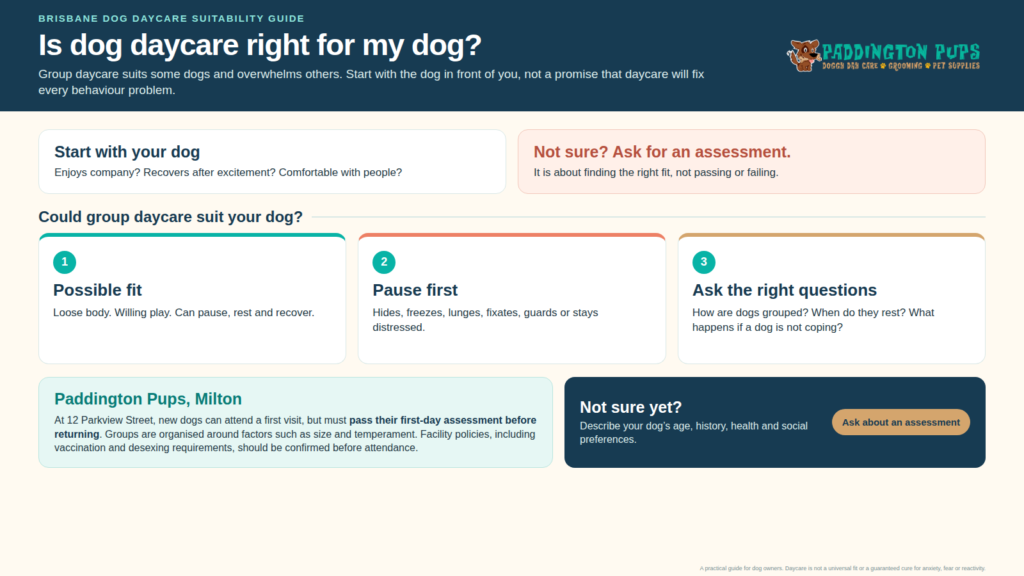
Start with four questions: Does your dog choose to interact with other dogs? Can they recover after excitement? Are they comfortable being handled by unfamiliar people? And are they healthy enough for a busy group environment?
If the answers are mostly yes, a carefully managed assessment may be a sensible next step. If your dog hides, freezes, lunges, guards resources, becomes overwhelmed or takes a long time to settle, discuss alternatives before placing them in group daycare.
A simple decision path looks like this:
- Look at your dog’s behaviour, not just their energy level. A dog can be energetic and still dislike group play. A quiet dog can enjoy short, gentle social sessions.
- Think about recovery. After meeting dogs or visiting a new place, does your dog relax fairly quickly, or do they stay wound up, avoidant or distressed?
- Ask for an assessment. A reputable provider should observe your dog before deciding which environment, group or care option is appropriate.
- Start conservatively. If your dog is accepted, ask how the centre manages rest, group size, introductions and feedback after the first visit.
What is a Daycare Assessment for?
A daycare assessment is there to find out whether the environment is suitable for your individual dog. It should not be treated as a pass or fail judgement on your dog’s personality.
During an assessment, staff may look at how your dog responds to unfamiliar people, new surroundings, other dogs, handling, movement, noise and changes in distance. They may also consider your dog’s age, size, play style, communication skills, health, history and ability to settle.
The aim is to answer practical questions:
- Does your dog appear curious, relaxed and able to engage?
- Can your dog move away from other dogs when they need space?
- Do they respond appropriately when another dog says, “That’s enough”?
- Can staff interrupt play and help your dog settle?
- Is there a suitable group or quieter option?
- Would another form of care be kinder and more useful?
A good assessment protects the dogs already attending as well as the new dog. It also gives you useful information, even if group daycare turns out not to be the right choice.
Which Dogs may Enjoy Dog Daycare in Brisbane?
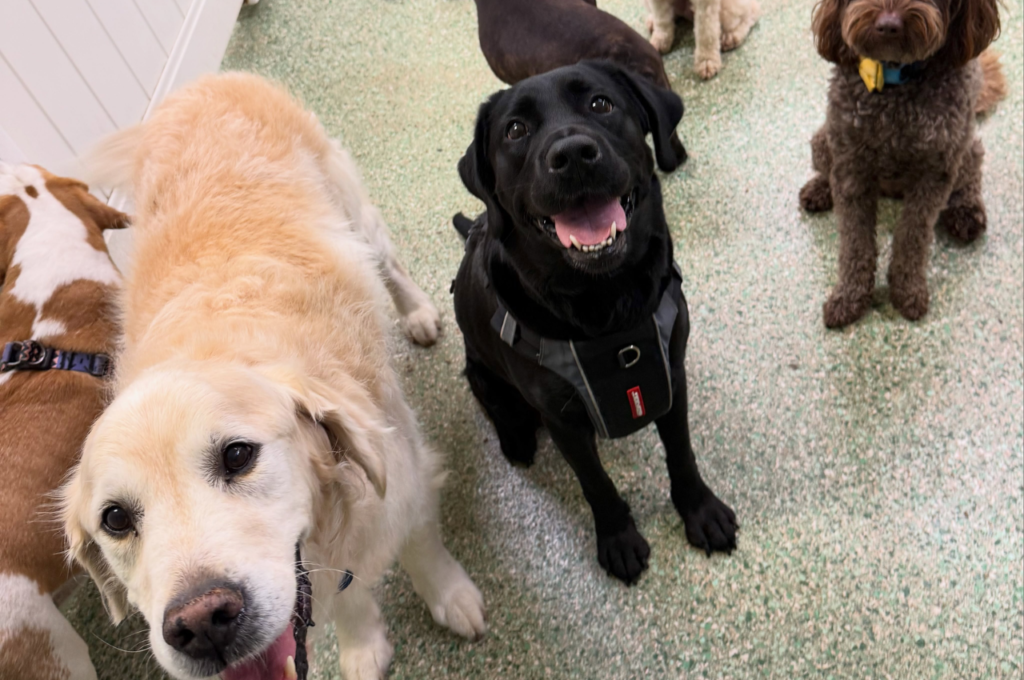
Some dogs settle into daycare well because they enjoy being around people and other dogs. Possible fit signals include:
- Your dog approaches suitable dogs with a loose, relaxed body.
- They show interest without constantly chasing, cornering or fixating on another dog.
- They can pause during play and return to a calmer activity.
- They recover quickly after a surprise or interruption.
- They are comfortable being separated from you for a period of time.
- They can share space without guarding food, toys, beds or people.
- They enjoy activity but can also rest.
These are signs to discuss with a daycare provider, not guarantees that your dog will enjoy every group or every day. Play should be mutual. Loose bodies, bouncy movement, play bows and dogs choosing to return to each other are generally more encouraging than stiff bodies, hiding, repeated avoidance or one dog continually pursuing another. Safe group-play guidance from the Animal Humane Society explains the difference between reciprocal play and interactions that need intervention.
Sociable adult dogs
A sociable adult dog may enjoy daycare as part of a weekly routine, especially if they already have positive experiences with different dogs and people. That does not mean they need to attend every day or spend every minute playing.
Ask how the centre balances social time with rest. A dog who comes home tired and settles comfortably may be coping well. A dog who returns frantic, withdrawn, unusually irritable or unable to sleep may be having too much stimulation, even if they appear to have “had fun”.
Puppies
Puppies benefit from carefully managed, positive experiences during their early development, but puppy socialisation is broader than letting a puppy play with as many dogs as possible. It includes people, surfaces, sounds, handling, travel, rest and learning that new experiences can be safe.
The Australian Veterinary Association says puppies should receive structured socialisation and habituation, with the intensity adjusted so they are not overwhelmed. The American Veterinary Society of Animal Behavior also supports safe puppy socialisation before full vaccination, with appropriate health precautions and veterinary guidance.
Daycare may or may not be the best first setting for a puppy. A puppy-specific class, small social group or one-to-one support may be more suitable than a busy adult group. Before choosing a program, ask about vaccination requirements, age groups, rest periods and how puppy play is separated from larger or more boisterous dogs. Our puppy socialisation and vaccination guide explains how puppy preschool and daycare differ.
High-energy dogs
High energy alone does not make a dog suitable for daycare. A working-breed dog may enjoy activity but still struggle with noise, close contact, frustration or constant play.
The best fit is a dog who can take breaks and respond to staff support. Daycare should be one part of a balanced routine, not the only way your dog gets exercise or enrichment. Sniffing walks, training, food puzzles, calm time and one-to-one activities may be just as important.
Senior dogs
Some senior dogs enjoy gentle company and a predictable day. Others find busy playgroups tiring, painful or stressful as their hearing, eyesight, mobility or tolerance changes.
Before considering daycare for an older dog, speak with your vet about pain, arthritis, heart or respiratory concerns, medication and safe exercise. A shorter visit, a quiet space, a small compatible group or a home-based sitter may be a better option than full-day group play.
When Should you Pause or Consider Alternatives?
Pause before group daycare if your dog is fearful, reactive, unwell, in pain, highly distressed when handled or unable to disengage from other dogs. Group daycare may increase stress for a dog who is trying to escape, hide or keep other dogs away.
Warning signs can include:
- Stiffness, freezing or repeated attempts to hide.
- Tail tucking, cowering, frantic movement or persistent avoidance.
- Lunging, snapping, repeated chasing or fixation on one dog.
- Escalating barking, body-slamming or rough play that does not pause.
- Guarding food, toys, people or resting places.
- Coming home unable to settle, unusually shut down or more irritable than usual.
A dog who has shown aggression toward dogs or people, caused an injury, or has a sudden behaviour change needs individual advice rather than a quick daycare trial. The RSPCA recommends veterinary advice when a dog shows regular signs of fear or stress, and a full behaviour assessment for aggression concerns. The RSPCA’s dog behaviour guidance is a useful starting point.
Alternatives may include a dog walker, home visits, a trusted in-home sitter, one-to-one training, a quiet small-group service or enrichment at home. For some dogs, the best answer is not more dog contact. It may be more distance, more predictability and more control over the environment.
Daycare should not be sold as a cure for separation anxiety, reactivity or fear. It can provide company while you are away, but behaviour concerns need a plan that matches the cause and the dog’s ability to cope.
What Should I Ask During a Dog Daycare Tour?
A tour is your chance to understand what a normal day looks like before making a decision. Ask:
- How do you assess new dogs before regular attendance?
- How are dogs grouped by size, age, play style and temperament?
- What happens when a dog needs a break?
- How often do dogs rest, and where do they settle?
- How many dogs does each supervisor watch?
- What signs would make you stop an interaction?
- How do you handle illness, injury, medication or a dog who is not coping?
- What information will you give me after the first day?
- What happens if my dog is accepted initially but later becomes uncomfortable?
- What vaccinations, parasite prevention and facility policies apply?
Look for staff who answer clearly and are willing to say that daycare is not suitable for every dog. Be cautious of promises that group daycare will cure a behaviour problem, guarantee a calmer dog or suit every breed and temperament.
What is the Paddington Pups Daycare Process in Milton?
Paddington Pups is at 12 Parkview Street in Milton, a short distance from Brisbane’s CBD. The centre offers indoor daycare with several areas, supervised social time, exercise and rest, with groups organised around factors such as size and temperament.
New dogs can attend a first visit without a regular booking, but they must pass their first-day assessment before returning. That gives the team a chance to see how your dog responds to the centre and whether the environment is a suitable fit.
The centre also has a desexing policy for daycare. Dogs aged six months and over must be desexed to attend. Dogs between six and twelve months who are not desexed may attend only with approval, based on veterinary advice and whether behaviour concerns may affect the group.
Dogs over twelve months who are not desexed are not permitted to attend daycare. This is a Paddington Pups facility policy, not a Queensland-wide legal rule.
Playgroups are divided according to size and temperament, and the team uses a time-out area when a dog needs to leave the group. If a dog shows ongoing aggression towards staff or other dogs, daycare may not be appropriate. The Paddington Pups daycare page provides the starting point for an assessment conversation, while the daycare FAQs cover visits, supervision, group matching and what happens if a dog is not coping.
When Should I Speak with a Vet or Qualified Behaviour Professional?
Speak with your vet before daycare if your dog is older, has a health condition, is recovering from illness or injury, takes medication, or has had a sudden change in behaviour. Pain and illness can affect how a dog responds to people, handling and other dogs.
For ongoing fear, anxiety, reactivity, resource guarding or aggression, ask your vet about referral to a qualified behaviour professional or veterinary behaviourist. The Australian and New Zealand College of Veterinary Scientists maintains information about veterinary behaviour specialists, including a list of behavioural veterinarians.
The goal is not to force a dog to tolerate group care. The goal is to understand what the dog is communicating and choose support that improves their welfare.
What is the Next Step if I am Still Unsure?
You do not need to decide from a photo gallery or a list of services. Describe your dog honestly, ask how the assessment works and pay attention to whether the provider talks about rest, consent, safety and alternatives as well as play.
Conclusion
Dog daycare may suit a sociable dog who enjoys supervised company, can recover from excitement and feels comfortable in a group. It may not suit a fearful, reactive, unwell or easily overwhelmed dog, and that is useful information rather than a failure.
A careful assessment, honest conversation and willingness to consider alternatives give you the best chance of finding care that works for your dog. The right next step may be group daycare, a quieter service, one-to-one support or advice from your vet and a qualified behaviour professional.