Home-Based or Centre-Based Dog Daycare in Brisbane: Which Is Better?

When you compare home-based or centre-based dog daycare in Brisbane, the honest answer is that neither option is better for every dog. Some dogs are happiest in a smaller home setting with a few familiar playmates. Others love the routine, space and social time that a dedicated daycare centre can offer.
 
The best choice is the one that suits your dog, not just the one that is closest to your house. Think about your dog’s confidence, size, age, energy level and experience with other dogs. Then look at the group size, supervision, rest routine, opening hours and first-day process offered by each provider.
 

Home-Based or Centre-Based Dog Daycare in Brisbane: What Is the Difference?

Home-based daycare usually takes place in a private home. Your dog may spend the day with the carer’s own dogs and a small number of visiting dogs. There may be lounge time, a secure yard, enrichment activities and plenty of opportunities to rest.
 
Centre-based daycare takes place at a dedicated dog-care facility. Dogs are placed into suitable groups and supervised by a team throughout the day. A centre may have separate areas for different sizes, energy levels and temperaments, along with spaces for rest and enrichment.
Here is a simple way to compare the two:
 
Feature
Home-based daycare
Centre-based daycare
Group size
Often smaller, although you should ask for the usual daily number.
May have several playgroups, depending on the size of the facility.
Setting
A private home with household routines.
A purpose-built daycare environment.
Routine
May be more flexible and home-like.
Usually follows a structured play, rest and collection routine.
Dog matching
Often based around the resident dogs and a small group of visitors.
May be based on size, energy, temperament and play style.
Best suited to
Dogs that prefer a quieter, familiar setting.
Dogs that enjoy supervised social time and can settle after activity.
 
There is no magic word that makes a daycare good. Home-based does not always mean quiet, and centre-based does not always mean busy or overwhelming. The way the dogs are grouped, watched and given time to rest matters most.
 

Which Daycare Setting May Suit Your Dog?

Your dog’s personality tells you more than their breed or size. A small dog may love a lively centre, while a large dog may feel much more comfortable in a home. Some older dogs still enjoy social time, and some young dogs need a slower introduction before they are ready for a full day.
 
Home-based daycare may be worth considering if your dog:
  • prefers a small social circle;
  • becomes overwhelmed around lots of dogs;
  • is more comfortable in a household environment;
  • needs frequent quiet breaks;
  • is small, older or still building confidence.
 
Centre-based daycare may be worth considering if your dog:
  • enjoys meeting people and other dogs;
  • likes activity and supervised play;
  • can move between playtime and rest;
  • benefits from a predictable weekday routine;
  • needs early drop-off or later collection around your workday.
 
These are only starting points. Your dog still needs to meet the provider and show how they respond in that particular environment.
 

What Is Good About Home-Based Dog Daycare in Brisbane?

Home-based care can feel personal and familiar. Instead of spending the day in a dedicated facility, your dog may relax in a home, spend time with a small group and follow a routine that feels closer to life at home.
 

Smaller groups can be easier for some dogs

A smaller group may make it easier for a carer to notice when a dog is tired, uncomfortable or ready for a break. Dogs that do not enjoy constant play may have more room to step away from the action.
 
Ask how many dogs are usually present. A service may call itself home-based, but the daily group can still vary. You should also ask whether the carer’s own dogs are part of the group and where your dog can rest separately if needed.
 

Some dogs enjoy a home-style routine

Some dogs love the simple things: relaxing indoors, eating at their usual time, playing in a secure yard and being around a small number of familiar dogs. That can be especially appealing for a dog that finds a large, noisy facility difficult.
  
That type of care may be a lovely fit for a dog that wants a home-away-from-home experience. It may not suit a dog that is uncomfortable around resident dogs or needs a larger space for exercise.
 

Small-dog home daycare can offer a quieter option

Small dogs can feel overwhelmed when they are surrounded by much larger dogs, especially if they are timid or inexperienced. A small-dog service can give them the opportunity to socialise with dogs closer to their own size.
  
Small-dog daycare is not automatically right for every small dog. The group still needs to be matched carefully, because small dogs can have different play styles, confidence levels and boundaries.
 

What Should You Ask a Home-Based Daycare Provider?

A home-based setting can be a great option, but it still needs clear safety and supervision arrangements. Before booking, ask:
 
  • How many dogs will be there on a normal day?
  • Will resident dogs, children or other pets be present?
  • Where will the dogs rest?
  • Is someone with the dogs throughout the day?
  • How are dogs introduced to one another?
  • What happens if two dogs do not get along?
  • How are doors, gates and outdoor areas secured?
  • What is the plan if a dog becomes sick or injured?
 
You should feel comfortable asking these questions. A good provider will be happy to explain how the day works instead of giving you only a general promise that the dogs will be cared for.
 

What Is Good About Centre-Based Dog Daycare in Brisbane?

Centre-based daycare can be a great fit for dogs that enjoy supervised social time and a regular routine. A dedicated facility may offer several play areas, a team of staff, indoor climate control, structured rest periods and a reliable schedule around the working day.
 

Purpose-built spaces can make group care easier to manage

A centre may be able to keep different groups separate. A gentle dog does not necessarily need to spend the day with a high-energy adolescent, and a small dog may be more comfortable with playmates of a similar size.
 
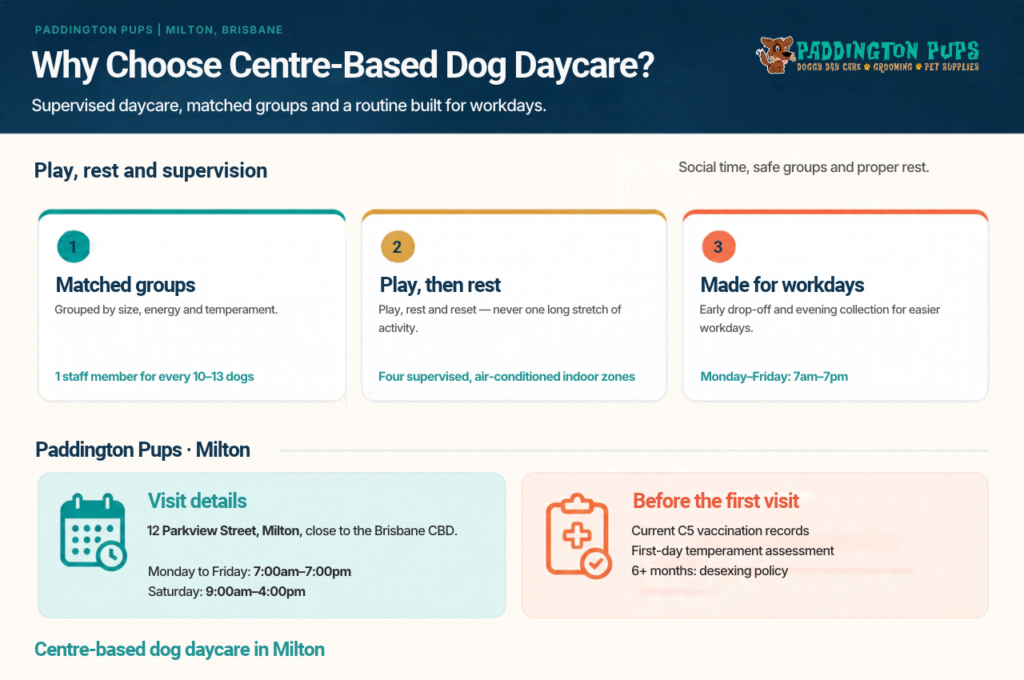
At Paddington Pups, we have four supervised, air-conditioned indoor play zones. We match dogs by size, energy and temperament, with one staff member for every 10 to 13 dogs and no more than 13 dogs per staff member.
 
We also build rest into the day. Daycare should not be one long stretch of running, chasing and wrestling. Dogs need time to settle, nap and take a break from the group.
 

Centre-based daycare can fit around a busy Brisbane workday

For many owners, the practical side matters. You may need to drop your dog off before work, collect them after the commute or use daycare on different days each week.
 
Paddington Pups is at 12 Parkview Street, Milton, close to the Brisbane CBD. We are currently open Monday to Friday from 7:00 am to 7:00 pm, and Saturday from 9:00 am to 4:00 pm.
 
Those hours can suit owners travelling from Milton, Paddington, Auchenflower, Toowong, Bardon and nearby inner-Brisbane suburbs. Of course, the best location is the one that works with your actual route, parking and daily schedule.
 

Some centres can combine several care services

A centre may also make life easier when you need grooming, hydrobathing or boarding as well as daycare. That convenience is useful, but your dog’s comfort still comes first. There is no point choosing a service that is close by if your dog is unhappy there.
 
At Paddington Pups, new dogs provide current C5 vaccination records and attend a first-day temperament assessment. Your dog needs to pass the first day before returning for later daycare visits. Our facility also has a desexing policy for dogs aged six months and over, with approval-only arrangements for some dogs between six and twelve months.
 
These are our facility requirements, not Queensland-wide rules. If you are unsure whether your dog is ready for group daycare, speak with us before the first visit and check with your vet if there are health or behavior concerns.
 

What Should You Ask a Centre-Based Daycare Provider?

When you visit or speak with a centre, ask what happens during a normal day. The most useful questions are usually about supervision, group matching and rest.
What to ask
Why it matters
How are dogs grouped?
Dogs should be matched thoughtfully, not placed together at random.
How many dogs does each staff member supervise?
A clear ratio helps you understand the level of direct supervision.
When do dogs rest?
A full day should include quiet time, not continuous play.
What happens if my dog is uncomfortable?
Staff should have a plan to separate, settle or contact you.
Is there a first-day assessment or trial?
A gradual introduction helps show whether the setting suits your dog.
What are the health requirements?
Vaccination and illness policies protect the dogs attending.
What are the drop-off and collection hours?
The service needs to work with your real commute.
 

Is Home-Based or Centre-Based Daycare Better for an Anxious Dog?

Neither setting is automatically better for an anxious dog. A home may feel calmer, but a busy household can still be stressful. A centre may have more formal assessment and separation options, but a group environment may be too much for a dog that is already worried around unfamiliar people or dogs.
 
If your dog hides, freezes, tries to escape, becomes stiff, repeatedly avoids other dogs or snaps to create space, they should not be pushed into group play. The explains that play should be willing and enjoyable for both dogs, with relaxed body language and opportunities to pause.
 
Daycare is also not a guaranteed treatment for separation anxiety. If your dog shows destructive behavior, excessive barking, pacing or escape attempts when left alone, the recommends speaking with your vet. A qualified behavior professional may be able to help you build a more suitable plan.
 

How Do You Choose the Right Dog Daycare in Brisbane?

Start with your dog, then look at the service. It is easy to be drawn to a beautiful facility or a sweet description of a home-based stay, but your dog needs to be comfortable with the actual people, dogs, sounds and routine.
 
Use this quick guide:
If your dog…
Consider asking about…
Loves social time and settles after play
A centre with matched groups and scheduled rest.
Is small and easily overwhelmed by larger dogs
A small-dog centre or small-group home daycare.
Prefers a household routine
A home-based service with a genuinely small group.
Needs long weekday hours near the CBD
A centre with opening hours that match your workday.
Has fear, reactivity or separation-related distress
An individual assessment before choosing group daycare.
Is older or low-energy
A quiet service with plenty of rest and individual attention.
 
The is a useful reminder that dogs need exercise, social interaction, mental stimulation, rest and individual care. The best daycare is not the one that keeps your dog busiest. It is the one that helps them feel safe and settled.
 

Why Some Brisbane Owners Choose Paddington Pups

We provide centre-based indoor daycare at 12 Parkview Street, Milton, for Brisbane owners who want their dogs to have a supervised, social day while they are at work or otherwise unavailable.
 
Our four indoor play zones are air-conditioned and matched by size, energy and temperament. Our team supervises the groups throughout the day, and we include rest as part of the routine rather than expecting dogs to play constantly.
 
We are open Monday to Friday from 7:00 am to 7:00 pm and Saturday from 9:00 am to 4:00 pm. New customers register before the first visit, provide current C5 vaccination records and bring their dog in for a first-day temperament assessment.
 
If you think centre-based daycare may suit your dog, . You can also or with questions before your dog’s first day.

FAQs

Is home-based or centre-based dog daycare in Brisbane better for every dog?

No. Home-based or centre-based dog daycare in Brisbane is a suitability question, not a universal ranking. The right option depends on your dog’s temperament, social preferences, health, size, rest needs and your daily routine.

It can be, especially when the provider keeps the group small and offers separate rest areas. A busy household with resident dogs, children or visitors can still be stimulating, so ask what a normal day looks like.

Neither setting is automatically safer. Look for active supervision, secure spaces, compatible dog groups, clear health requirements, rest periods and a realistic emergency plan in either model.

Ask about group size, matching, supervision, rest, health requirements, assessment or trial arrangements, emergency procedures, opening hours and what happens if your dog is not coping. A good provider should be comfortable answering these questions clearly.

It may suit some small dogs, especially those that feel overwhelmed around larger dogs.
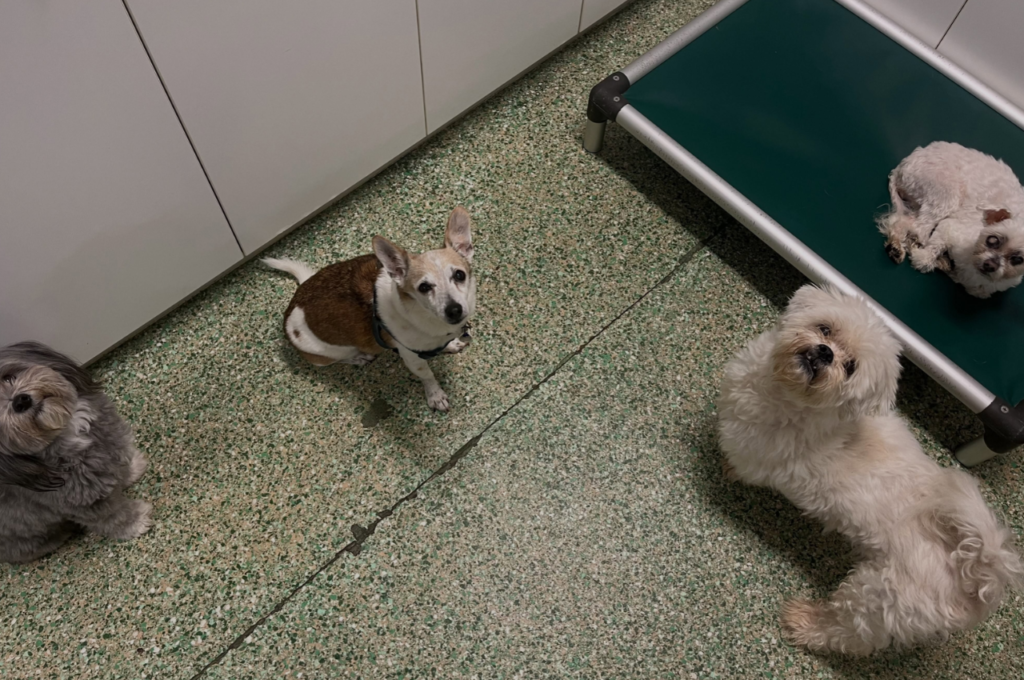
Dogs resting and socializing indoors in a clean, professional dog daycare facility.